Google
Showing posts with label Movies. Show all posts

Wednesday, September 19, 2012

My Fair Lady - Movie Review

If I was to imagine what the Protagonist of this movie had to say, was he was to review it; here is how it would go, "Surely you've watched this one? If you haven't, I believe you've been deprived of some cultural upbringing, old chap. It's not you that's at fault. It's what's lacking in you. If you were to watch this movie carefully for six months, and learn every dialogue carefully, I'm sure you could give one Mr. Roger Ebert a run for his money.Or perhaps run a video store successfully, because at the very least, you'll possess a taste in cinema once I'm done with you."

Ludicrous as it sounds, but such is the rationale of Professor Henry Higgins. A word or perhaps two about this renowned academician - patronising and overbearing. Professor Higgins in a gifted linguist in his own eyes, while being an egotist par annoyance in full public view. He's the kind who may not take offence at what the author just called him, but would frown at the improper use of "par", and writhe in pain at the unsuccessful attempt at wordplay. Here's what he thinks of English speaking peoples ( "People!" as Higgins would insist)  - 


This is what the British population, 
Calls an elementary education.

Hear them down in Soho square, 
Dropping "h's" everywhere. 
Why can't the English teach their children how to speak? 
This verbal class distinction, by now, Should be antique. 

If you spoke as she does, sir, 
Instead of the way you do, 
Why, you might be selling flowers, too! 
Hear a Yorkshireman, or worse, 
Hear a Cornishman converse, 
I'd rather hear a choir singing flat.
Chickens cackling in a barn 

Just like this one! 
(Eliza responds with "Garn!")I ask you, sir, what sort of word is that? 
It's "Aoooow" and "Garn" that keep her in her place. 
Not her wretched clothes and dirty face.


At this juncture, we are introduced to Eliza Doolittle. Clearly a woman who's made it on her own as a flower seller, Eliza refused to be mocked at her modest upbringing. At which point, Henry makes a claim that would go on to define the movie. He would wager any amount to turn this modest flower girl into a woman who would be mistaken for royalty if only he was to impress upon her the virtues of the English language. While it was spoken in jest, the offer of a better lifestyle in exchange for a few days' lessons seemed too much to resist for poor Eliza. And she duly took up on the offer by appearing unannounced at the Professor's regal mansion.

The Terms and Conditions were agreed upon. " Eliza, you are to stay here for the next six months learning to speak beautifully, like a lady in a florist's shop. If you work hard and do as you're told, you shall sleep in a proper bedroom, have lots to eat, and money to buy chocolates and go for rides in taxis. But if you are naughty and idle, you shall sleep in the back kitchen amongst the black beetles, and be wolloped by Mrs. Pearce with a broomstick. At the end of six months you will be taken to Buckingham Palace, in a carriage, beautifully dressed. If the king finds out you are not a lady, you will be taken to the Tower of London, where your head will be cut off as a warning to other presumptuous flower girls! But if you are not found out, you shall have a present... of, ah... seven and six to start life with as a lady in a shop. If you refuse this offer, you will be the most ungrateful, wicked girl, and the angels will weep for you."


What follows is easily the most romantic movie you'll see never to feature a kiss. The build up comes from an interesting chemistry that the two protagonists share in their battle of egos. On one corner, you'll find a paragon of chauvinism with a penchant for PR that's Victorian in its form. Here's exhibit one,Why can't a woman be more like a man? 
Men are so honest, so thoroughly square; 
Eternally noble, historic'ly fair; 
Who, when you win, will always give your back a pat. 
Well, why can't a woman be like that? 
Why does ev'ryone do what the others do? 
Can't a woman learn to use her head? 
Why do they do ev'rything their mothers do? 
Why don't they grow up- well, like their father instead? 
Why can't a woman take after a man? 
Men are so pleasant, so easy to please; 
Whenever you are with them, you're always at ease. 


On the other corner is a skinny Eliza Doolittle who by the sheer heart for a fight manages to punch well over her weight to stand up to condescending upper-class pricks like Higgins. Eliza 1 : Circumstances 0

" There'll be spring every year without you. England still will be here without you.
There'll be fruit on the tree. 
And a shore by the sea. 
There'll be crumpets and tea without you.

Art and music will thrive without you. Somehow Keats will survive without you.
And there still will be rain on that plain down in Spain, 
even that will remain without you.
I can do without you. "


Critics believe this movie was a triumph. Audrey Hepburn and Rex Harrison were suitable, if not the ideal selections for the characters they played. The screenplay was perhaps nothing more than a tasteful screen rendition of GB Shaw's Pygmalion, from which much of the wit is inherited.And the movie was perhaps not as entertaining as the Broadway production. It's impossible for us to make such a comparison. But to me, the movie is a triumph for reasons far beyond cinematic excellence.  

What I loved about this war of words is the underlying theme. A man is always judged by the words he speaks. It allows the world to place him immediately. At times, it also allows him the luxury of taking his place in society for granted. His actions however will always finish a distant second. It's a disease that's as rampant in India today, as it was in England when GB Shaw wrote Pygmalion. This sentiment is best expressed by Mr. Doolittle, father of Eliza, when he offered to "Sell" his daughter for a mere 50 pounds. When asked if he had any morals at all, the man replies in his inimitable dialect, " 
Nah. Nah, can't afford 'em, guv'nor. Neither could you, if you was as poor as me."


Rarely has such a powerful statement been made in a manner that's so delightful. Here's another dialogue that aptly sums up what the 3-hour movie is all about, "The difference between a lady and a flower girl is not how she behaves, but how she is treated." To me, this is the essence of My Fair Lady.


Monday, February 20, 2012

The Artist - Movie Review

By the time I publish this review, the film world may already be raving about this path-breaking movie. Well, it's not really path-breaking in the strictest sense of the expression. Because this movie is a lot like what movies used to be at the very beginning, when it didn’t matter what you wore, or what you sounded like. And in an era when CGI is passé, and plastic surgery is what the doctors at Hollywood order, this back-to-the basics approach to film making is most refreshing.

So what is it that really works for this silent black & white movie, with mostly unknowns in the credits? For one, it relies on the abilities of the actors. Never before did the age-old cliché of “action speaking louder than words” hold true. And the Screenplay, for pretty much the same reason.

The movie takes us back to 1927, when Actor George Valentin (Jean Dujardin) enjoys a Midas touch with his movies, and charms audiences with his silence. With a stature that would make Douglas Fairbanks look like a metrosexual, Valentin looks like he has come to grips with stardom, and clearly knows what the masses want. However, it in this very department that he proves to be a little myopic.

At the peak of his career, he brushes off the latest developments in sound recording, and continues to live his charmed life with gay abandon. As a ‘silent’ expert, it seemed like sound judgement at that moment. But that’s a decision that would let his fortunes dry up.

Typically as silent films go, the protagonist becomes a pale shadow of his old self when he encounters testing times. And as with 89.64% of movies, when the going is bad, it’s really bad. The film has a few central themes running through it – how change is inevitable, how our male egos come in the way of letting ourselves have a go with the women we adore, and how stubbornness masquerading as strength totally kills one’s drive for success. The Artist continues this simple plot without any undertones of irony or lessons on morality. It is a fair depiction of a time when what you saw was essentially what you got at the movies.

But while the plot is simple, it still manages to keep you hooked, and that’s the reason why I believe director Michel Hazanavicius and his team deserves their share of accolades. With the smartest use of a forgotten medium, it is perhaps a reminder to everyone in the industry today of how we stand at that very precipice of changing times, much like protagonist of the film. Emerging technologies will always continue to change the way movies are made, and in the bigger picture, change life itself. But would we still continue embracing the familiar and render ourselves obsolete? Some questions are perhaps best left in the rhetoric.

The Artist may not win as many Oscars as I think it deserves. It would be a pity if it loses out to some of the more popular names in its categories. Either way, I hope the producers of The Artist don’t express their triumph or failure as vocally as moviemakers are known to. Because, as they’ve shown it with their silent film, they say best when they say nothing at all.


Sunday, June 19, 2011

Fire in Babylon: Movie Review


In a cricketing world where batsmen are as protected from head to toe-nail as Samurai warriors with Katina Blades (read cricket bats), the West Indians no longer remain a force they used to be for a little over two decades from the 70s. And it’s a cruel 157 Km/h beamer of an irony hurled at bowlers today, West Indian or otherwise, that the best of their ilk were responsible for the movement that protected the batsman, which has led to fast bowlers becoming an endangered species. This documentary called Fire in Babylon is made to inspire the kind of people who are up against preponderance today – Fast Bowlers, Faster Bowlers and Batsmen who look a bit like healthy cross of Romesh Powar and Fred Flinstone.

Much like Indian Cricket teams till the late 1990s, the Men from the Caribbean were known to be entertaining visitors, who lost games but won hearts for their stylish attitude towards the game. Barring a handful legends whose names now grace the cricketing stands and trophies around the world, the rest were supposedly as competitive as cows grazing on fields of hemp. But one fine day, when they couldn’t take Caucasian taunts anymore, these very cows turned into raging bulls that were desperate for action on the field(mating season or otherwise). Fire in Babylon begins at that precipice of transition in the minds of Caribbean Cricketers. Never again, would they only play and not compete, said captain courageous Clive Lloyd.

The journey begins with Lloyd choosing his men wisely and encouraging them to make a statement on the field with their talent. As a result, the batsmen scored more runs, bowlers took more wickets, fielders took sharper catches, and Jamaican fans scored more pot. It’s really a simple story of pretty boys becoming poster boys of brute force. But where Fire in Babylon really scores is in its re-narration of Ugly Duckling into one that inspires movie audiences to do a Mexican wave.

Underlying their cricketing achievements, was a lot that happened off the field in their respective island nations – political strife, with casual racism, the legacy of colonial exploitation, and a burning desire to be acknowledged as an equal. It was cricket that united several nations under the West Indies flag. It was no longer the pride of playing for your country alone, but it was the pride of representing a significant population of mankind.

Switching between archival footage and present day interviews with the stars of the 70s-80s including Clive Lloyd, Gordon Greenidge, Desmond Haynes, Viv Richards, Andy Roberts, Joel Garner, Collin Croft and Michael Holding, the film takes you through a fascinating journey that weaves socio-political and sporting elements into a narrative that's compelling even for those who don’t know their Sidebottoms from their elbows.

This movie helps you get a global perspective in a cricketing context. It opens your eyes to double standards that had emerged when the West Indian Bowlers ruled cricket with intimidating pace. It also helps you understand what really motivates a champion side to go far beyond what is expected of them. Fire in Babylon is a story of controlled rage with a healthy dose of Reggae. And above anything else, it’s a grand tribute to one of the greatest and the most dignified cricket teams ever to grace the field. Which is what makes it a spectacular viewing for any cricketing fan worth his Cricinfo addiction.

Wednesday, November 24, 2010

Harry Potter and the Deathly Hallows part 1


Statistics prove that the movie watching populace today is clearly divided into two parts. Those who know the difference between petrify and stupefy (may their numbers grow), and those who think these are no more than two words from Webster’s Dictionary. And the latter is an aging race that diminishes in number every time someone turns a page.

For the 11 of you who read this blog, and the 61 of you who haven’t read a single book of Harry Potter (and who, almost certainly, don’t read this blog), the seventh installment of this top-grossing movie franchise might be the safest place to begin the journey. Only because, Deathly Hallows part 1 is completely devoid of anything out of a textbook on magical creatures. Well, almost. Also, there are absolutely no boring potion classes to attend. No new spells to learn. No pretty seniors to ‘charm’. No accidents on the Quidditch field. No points to be won for Griffindor house. No Hogwarts rules to be broken. For Potterheads, it’s almost tantamount to being expelled during the Happy Hours at the Three Broomsticks. This is undoubtedly the most non-magical movie about the wizarding world.

Simply put, it’s a story of three young wizards, Harry, Ron and Hermione, who are absconding from the wizarding world in search of something called hocruxes. That it happens to be a bone of contention for Lord Voldemort (very much like Darth Vader from our times) is inferred when his minions called ‘Death Eaters’ (the dark forces) wreck havoc while chasing the three friends. And just as you figure out what the title actually alludes to, you realise that you’ve just watched the longest movie trailer ever, clocking at 150 minutes. Confused? Surely. The movie really wasn't made for you anyway.

But then, as your young friends will tell you, you need a lot more than just a wand or some spell to create some magic. And this movie is visual proof of what Dumbledore meant when he said something in the tune of ‘Love and friendship can encompass everything. Even that which your wand can’t’. (Well, something of the sort. Only read the books once, you know. But you get the drift, don't you?)

While DH part 1 may seem very distant from the magical realms of Hogwarts, it is the one movie that is most loyal to its protagonists. For once, we know more about Harry, Ron and Hermione without ever getting distracted by their academic or trivial pursuits. Here are three friends, who have been driven out of their cocoon of adult supervision, and are racing against time to survive several onslaughts from the dark forces of Lord Voldemort. And the only thing working for them, when even their own wands fail, is each other’s company. But then, it is under such immense pressure that the strongest bonds are forged. Here's where the world of wizards comes closest to reality.

The utter frustration of the characters under overwhelming odds considerably slows down the pace of the movie. At times, you feel as impatient as the characters themselves. At times, you feel a sense of nostalgia, thinking of the good old days at Hogwarts. At times, you are left wondering if it’s a children’s movie any more. The harsh reality dawns upon the characters and the audience alike, that childhood was a thing of the past. And life will only continue to be unfair. So much so that a few lighter moments that emerge out of long dark hours seem no more than a fleeting respite. A Waltz between Harry and Hermione when they are on the verge of giving up is one such poignant moment.

There are two other sequences that will remain etched in the memory for some time. Firstly, there’s Hermione who reluctantly erases herself from her parents’ life, thus keeping them out of harm’s way. And then there is an animated narrative of the legend of the Deathly Hallows. These were the best sequences in this movie.

However, for all its brilliance, DH part 1 does offer an unbiased critic a lot of scope for nitpicking. The effect of wearing a hocrux surely reminds you of Frodo Baggins. Lord Voldemort certainly doesn’t seem half as scary as he’s made out to be. And then, as is the case with most movies that are based on books, DH part 1 proves to be the proverbial mini-skirt, concealing a whole lot more than what it reveals. But among book-based movies, I’d rank DH part 1 alongside Godfather 2, in that it lays greater emphasis on the characters of the story, as opposed to the main plot. That was one aspect of the movie I found most fascinating.

Of course, we do realise that a critique for any movie from this franchise is a futile exercise. If you do watch this in a theatre, just pay attention to the disappointment of the 10-year old who is a complete authority on all magical creatures Harry has encountered so far, or the ecstatic 12-year old who has all the magical spells by heart, and is completely armed to fight in the Battle of Hogwarts, come July 2011. That to me is the best critical analysis Deathly Hallows part one can get.

Thursday, May 6, 2010

Redline (2007)


Redline is proof enough that creative minds are caught in the slowdown, too. It's hard to imagine how anybody worth his D grade in a course on film-making can release a ridiculous movie like this.

Redline features an ensemble cast starring a Mercedes SLR McLaren, a Ford GT, a Ferrari Enzo, a Lamborghini Murcielago Roadster and a Lamborghini Diablo Roadster. At least these have more personality, if not curves, than the actors driving them. Cheesy dialogues, corny one-liners and a masaleydaar plot are the other main ingredients in what is otherwise an automobile orgy with actors being the quintessential well-equipped nurses in a porn flick - mere visual props.

Read complete review here.

Tuesday, May 4, 2010

Watchmen - Movie Review


Who watches the Watchmen?

Any comic geek-boy worth his Batman tee and an issue of DC Comics will tell you that this is the phrase that inspired the title for Alan Moore's 12-comic-book magnum opus, Watchmen. But the double entendre that the question becomes with regard to this Zack Snyder cinematic catastrophe seems as perplexing to answer as the rhetoric that the novel sought to address two decades ago.

Read the complete review here.

Sunday, February 28, 2010

Law is Sherlock's Ho(l)mie.

I'd read my first Sherlock Holmes novel,"The Hound of Baskervilles" when I was 10. And even though I was awe-struck by the sheer skill and astute observation that defined Sherlock Holmes, Baskervilles remained my last Holmes till much later in life. So while I cannot claim to be his biggest fan, I was impressed enough as a 10-year-old, as is the case with the inherent innocence of age, to believe there is as much reality in Conandoyle's fiction as there was in being thrown out for reading his book during class hours.

Guy Ritchie's version is probably Arthur Conandoyle's version '+' not-so-healthy amounts of Nicotine rushes '+' a few joints here and there '+' one ecstasy in the intermission '+' one three hour acid-trip '+' one jab in the posterior '+' one kick in the groin.

Yet another childhood hero goes down the CGI route, with the innocence of childhood reading fast meeting a gut-wrenching end. Guy Ritchie's film is filled with sensational sights, over-the-top characters and a desperate struggle atop Tower Bridge, which is still under construction (A great case of attention to detail, mind you!). While it's likely to give a tremendous boost to Holmes' fan-following, the 'Baker Street (Ir)Regulars' will settle for going back to the books.

If you wondering why this reviewer has not got into the plot of the film, we pray you'll need to wait some more. Ritchie's Holmes requires an introduction for movie watchers who haven't read the book; even those who have, given that Ritchie has converted the great detective and his 'partner-in-crime' into the boxing and martial-arts champions of London. While that is not so far away from the series, with Holmes being an expert in Baritsu, the portrayal is ridiculous, yet entertaining. The audience are introduced to the Detective's deductive powers when the man envisions his fight sequences in super slow-mo and dead-pan mental commentary, and executes it to the last broken rib in whip-lash reality.

The plot challenges the viewers' intelligence, never mind the detectives own. The villainous Lord Blackwood, arrested and executed for voodoo practices in the opening scenes, somehow engineers his return from the dead and hatches a nefarious plot to rule the British Empire. While this would send the great Sir Arthur Conandoyle rolling big-time in his grave, and smoking it up too; he may not really criticise Ritchie's character sketches and the settings of London in the late 19th century.

Also the movie's dialogues are very characteristically Ritchie, with several great references to Conandoyle's stories, which keep the Sherlock Holmes fans happy. Downey provides his character the brains, the wit and the thinking-on-the-feet it deserves, and Law erases our own perception of Watson as a mere sidekick, by being a a fleet, dapper and a womanising Dr. Watson, who also enjoys a bit of an intimate 'bro'mance with his good friend and colleague.

Sherlock Holmes will continue to remain a must-read among school kids, and the greatest service this movie could do is to get kids today to go beyond Harry Potter in the world of literature. And the fans who will revisit all the novels and the short stories will picture Robert Downey Jr. and Jude Law in their minds. We're guessing that the character of Sherlock HOlmes which has survived among other things, great illness, substance abuse, a broken heart, a few scandals and abject failure to commercialise, will surely survive this new Avataar of SXF and CGI, and continue to be bored by a sedentary life.

Sunday, October 4, 2009

Inglorious Basterds


Quentin Tarantino is known to make films that are full of legendary contradictions, real-life references and imaginary events, inspired/borrowed elements and dazzling original plots, and mind-numbing absurdity and deep-layered meaning - often rendering them as brilliant as they are ridiculous. And we movie buffs love him for just that. Suffice it to say, Inglourious Basterds is Tarantino's most glorious attempt since Pulp Fiction.

Read the full review here.

Friday, May 22, 2009

The International


The International is an offshoot of James Bond hit by a credit crunch and Jason Bourne with a flat foot. Read my complete review here

Monday, May 18, 2009

Monsters vs. Aliens


For Monsters vs. Aliens, we'd gladly trade our horn-rimmed movie critic spectacles for 3D glasses. Read my complete review here.

Monday, April 27, 2009

Movie Reviews

Oh boy! Reviewing movies is fun. And we learnt a couple of lessons too. Here they are:

1. A "bad-movie" review need not necessarily be a bad "movie-review". Check this out.

2. A director may remain strictly loyal to the book or the graphic novel, but then he'll still fail to please both the author and the reviewer. Check this out.

Sunday, March 1, 2009

The Curious Case of Benjamin Button


What if you were born in an old–age home? If you go through your wheelchair days when you are 5, bed-pan days when you are seven, BP and Sugar tests when you are 9, only to be gifted a huge fixed deposit when you are 13, earning a golden watch on your first day at work, start with huge pay checks and bonuses without mortgages in the early years of your career, which also get you your Porsches, and your French villas, that will help you get over your mid-life crisis and stressful career, so that you keep getting fitter and sexier, and this happens until you reach the age of 58. After which you retire to go to college, where you party like there is no tomorrow, where your only worries are pimples and acne, and learn to enjoy life by living for today, blowing up your non-taxable stipend from your job at McDonalds on your dates and weekend raves. Not to mention extracurricular activities in school, your brushes with crushes, homework that keeps getting simpler with advancing years, after which your stints at school get shorter, where you reminisce your struggle of your early years by playing with Barbie dolls and Hot Wheels, after which your skin and hair gets softer, and you become cuter by the hour, all this to end up in one hell of an Orgasm!

The Curious Case of Benjamin Button is the above paragraph stretched over three hours. And yes, it is a little too laboriously long in the earlier half of the protagonist’s life

My name is Benjamin Button, and I was born under unusual circumstances. While everyone else was aging, I was gettin' younger... all alone.

Loosely based on an F Scott Fitzgerald short story, it’s a tale armed with a concept that could titillate the senses of the most demanding of movie critics. The possibilities of exploring the world through the eyes of an 80-year-old Brad Pitt getting younger everyday seemed immense. Our hero is born as a tiny, shrivelled fossil and then seems to defy chronology. Incredible adventures follow: a spell on a tugboat, wartime peril, voyages that transcended much geography, and the backdrop richly woven with the jazz era during the roaring twenties, the depressing 30s, the World War days in the 40s all the way till the stormy days of Katrina.

The young (old?) Benjamin is a winning creation, a mesmerising byproduct of Gollum and Forrest Gump. But once Benjamin morphs into Pitt in all his Greek God glory, you feel the movie’s “curious” charm begin to dissipate. Soon we’re left with something that resembles an all too conventional romantic drama, The Bridges of Madison County with a steadily diminishing echo of fantasia.


Along the way you bump into people who make a dent on your life.

There is also an interesting take on Button’s decades-long romance with a ballerina (a stunning performance from Cate Blanchett), which proves that the lifetime of true love, like comedy, is all about timing.


It's a funny thing about comin' home. Looks the same, smells the same, feels the same. You'll realize what's changed is you.


Another aspect of The Curious Case that started troubling me a bit while watching the movie was its striking similarity to Forrest Gump. After perusing IMDB, I was hardly surprised. We could just blame the scriptwriter, who tried to reproduce his magic from Forrest Gump. But then, as any magician will tell you, you cannot get away with a performance when you have no new trick up your sleeve.

Sometimes we're on a collision course, and we just don't know it. Whether it's by accident or by design, there's not a thing we can do about it.

Benjamin’s condition does not seem inspire him all that much, to have given him any unique insights. But then the script seems to force Benjamin to make Forrestesque observations which are then made to sound like profound truths. Some pearls of wisdom such as “Live the life you’re meant to live”, “Love while you can” and “Nothing lasts for ever” will only take your mind back to Tom Hank’s adorable portrayal in his 1994 Oscar winning role.

Our lives are defined by opportunities, even the ones we miss

Where this movie disappoints is at the climax. While we sit through his old age anticipating exciting times as he gets younger during the Beatles mania, the movie flatters to deceive. What ought to have been an orgasm after a nearly three-hour foreplay, turns out to be a premature ejaculation.

I think, right there and then, she realized none of us is perfect forever.


But then, when I did watch the movie at a multiplex, without horn-rimmed glasses of a movie critic, I found it entertaining. In fact, I’d go to the extent of saying that it is easily one of the best movies made in recent times. If you can forget the fact that it is directed by David Fincher of the Fight Club fame, and the screenplay was indeed written by Eric Roth of the Forrest Gump fame, you will surely like the movie, and may even get yourself to love it. The movie was certainly not as forced and futile as this review is, but then, beware of the staccato.

You must watch The Curious Case of Benjamin Button if you are the kind who likes to live today like there is no tomorrow. And watch it most certainly if you, like this reviewer, dread the thought of your birthday, because it’s a reminder that you’re getting older.

Saturday, January 31, 2009

Some Dog is a Millionaire!

Slumdog Millionaire is the story of a slum-dweller who was born and brought up in what is depicted as the crap-pit of the world. But he’s like no other. He decides to grab the world by its crack, and beat the crap out of it. He’s the kind who takes all the shit that the world doles out at him, only to emerge a victor, eventually. The only difference between this movie and several Indian movies which celebrated the underdog’s life in the 50s is the fact that Danny Boyle, the director of SM, focused on the “crappy” part of slum life with details that went to tasteless proportions.

But why has it elicited praise and accolades from western critics, while it continues to face the wrath of various sections of the Indian public. The answer, I believe, lies in the differing perspectives of Indians and the rest of the world about abject poverty.

Danny Boyle’s SM was a bullet which shattered the Kevlar that protected me from the knowledge of life in Mumbai’s Slums. Has he or any of the members of SM’s Team experienced life in Mumbai’s Slums, you ask. I cannot say for sure, because I never wanted to know what lies beyond whatever little I saw of Dharavi, from the window of a local train. Honestly, I’d turn away from the stench and avoid the ghastly sight. I’d never even mention this place when I spoke of the city I loved dearly. Never had I thought Dharavi could actually inspire a thought, leave alone poetry, songs, music, a story, romance or anything with a remote semblance of a good life. This is where we should draw a line with our cynicism and appreciate Boyle, Rehman and everyone involved with the fairy tale that is – Slumdog Millionaire.

While Bollywood Directors spend millions of dollars to fund their “dream” projects in “dream” locales, here’s a Brit who found his latest “love story” in the most disowned area of Mumbai, in the labyrinthine lanes of Dharavi. I’ve not read Vikas Swaroop’s book to use it as a parameter to judge the screenplay, so I’ll just speak of everything else.

Firstly, if we had a scale which would have artsy and masala on the two ends, SM would be inclined towards the latter end. It is neither a Bicycle Thief that would inspire Ray to make Pather Panchali, nor is it a DDLJ that would inspire every production house to make movies with larger-than-life NRI storylines, which would relegate Laxmi Mittal’s opulent lifestyle to modesty. Slumdog’s different.

SM narrates the life of a slum-dweller, who turns into a renegade, fighting all the norms of a “slumdog” – a term that has offended many. It is Jamal’s pursuit of love against all odds – poverty, religious vandalism, child abuse, fraud, the underworld, prostitution, organized crime, violence, economic and social disparity, corruption, and everything else that every Indian would turn their head away from in shame. And yet, he emerges a victor. “Larger than Life”, did I hear you say? But why “dwell” so much on all these ills, you ask. It is because we have simply refused to do so ourselves, “dwell” on the subject that is, that we are not able to digest Boyle’s bold portrayal. How much can a vilayati possibly sugarcoat the crap, which is life in the slums?

Now coming to the direction and editing. Brilliant! Each answer on the TV show becoming a key that unlocks the pandora’s box of Jamal’s past, a narrative device kept from cliche by deft direction and slick edits. And SM is certainly not without its share of inspiration. Black Friday and Satya probably had a big role in shaping Boyle’s directorial route, but that’s taking no credit away from the chase sequence early in the movie. Lathi-laden Havaldars chasing a bunch of brats all over Dharavi, with “Oh Saya” is the background is undoubtedly a directorial masterpiece.

There is also a powerful visual interpretation of Mumbai. The movie, much like the city itself, overflows with opposites. Paradoxical collisions were never known to make a memorable cocktail - horror and joy, colourful fantasy and grimy reality, history and hyper-modernity. Through SM, we find that there are rich hues in the homes of the poor, beauty in the grotesque, music in noise, happiness in sad living conditions, and poetry in poverty. Haven’t we been guilty of turning our aristocratic heads away from Dharavi, because it inspired little? Hasn’t this westerner just exposed our myopic outlook of cinema, and life in general?

As for Rehman’s original background score, which may win him a maximum of two Oscars, though being far from his best, it was apt, definitely worthy of an Oscar if it wins one. Rehman composed music that fit the mood of the film like a glove, much like the soundtrack of Atonement or American Beauty did for their respective movies. And I reiterate, “Oh Saya” rocks!

Another debate doing the rounds among the intellectual circles in India is if SM really deserved 10 nominations. In response, I’ll say Slumdog will only compete with movies that have been released in 2008. It’s not competing with a Life is Beautiful or a Schindler’s List. So either we celebrate the production of a well-executed movie, or a fall in the standard of movies competing for the Oscars. If it wins an Oscar for the best movie, Bollywood will proudly flaunt her Digitus Impedicus to her glamorous sister in LA.

To sum it up, Slumdog Millionaire is a feel-good movie. You’ll be glued to your seats, just like the time when you cheered Harshvardhan Navathe, who went on to become the first Crorepati on KBC. You’ll rejoice the triumph of Jamal at the denouement, just as you jumped with joy when Shreeshant held on to a skier, which brought India the first T20 World Cup. And you’ll even be implored into dancing in the very streets where this movie was shot, or sing “Jai Ho!” at CST (I thought it looked like Victoria Terminus, but correct me if I’m wrong). Alright, maybe that’s pushing it too far. Probably that’s sending reality into a different Space-Time coordinate. But then, isn’t it what we come to expect from movies?

Wednesday, October 22, 2008

"Once" Smitten !


I don't know you
But I want you
All the more for that
Words fall through me
And always fool me
And I can't react

Victor Hugo said “Music expresses that which cannot be said, but about which it is impossible to remain silent.”

“Once” believes that statement with every fiber of its heart and soul, and its heart and soul are so pure, so warm, so loving, one cannot help but feel the man was right. Here is a movie that deeply explores the clichéd “girl-meets-boy” theory and renders it into an unprepossessing gem which is utterly magical.

A Dublin musician performs covers for the crowds by day and his own compositions to the empty sidewalk by night. However, a young Czech woman listens to his straining voice and discovers something that passers-by fail to hear. A Love Story!

I'm scratching at the surface now
And I'm trying hard to work it out
So much has gone misunderstood
This mystery only leads to doubt
And I didn't understand
When you reached out to take my hand
And if you have something to say
You'd better say it now

“Who did you write that song for? Where is she? Is she dead?” She asks. While the woman’s style lacked subtlety, it was not lacking in charm. And this brings together what is easily one of the most romantic movie couples of the decade.

This endearing association feature in a few duets, which could at best be described as poetry in motion-pictures. “Once” has some unforgettable scenes, especially the one that features the couple playing the piano at the music store, which leaves the shop owner completely in awe of the artists.

Falling slowly, eyes that know me
And I can't go back
Moods that take me and erase me
And I'm painted black
You have suffered enough
And warred with yourself
It's time that you won

“Once” is a movie that’ll remind you of Richard Linklater’s Before Sunrise. A movie that creates romance by featuring the couple in no more than a peck on the cheek is definitely from Linklater’s School of Romance. It’s a movie that’ll make you want to believe it’s true. It’s a movie that’ll make you want to make a movie, write a song and sing it. Its soundtrack will make you want to get out on the road in in your pyjamas and bunny slippers and sing along as you savour its tunes on your iPod. And most importantly, the movie will make you want to watch it just “once” more!

Falling slowly sing your melody
I'll sing along

Tuesday, August 5, 2008

Rajni can't? Of course he can!


So do you really know Rajnikant? read on...

1. Rajni keeps himself entertained out of concern for the public. If he gets bored, he'd yawn and the last time he yawned, it caused a tsunami.

2. Legend has it that Rajni was once a certainty in the Indian cricket team. As a bowler, Rajni usually needed 10 deliveries to finish the game. Owing to monotony, he retired from cricket as a 12 year old.

3. Tamil Nadu was dry one summer. Poor monsoons had resulted in a drought. But then this was only until Rajni sneezed! Bless him!

4. Wachowski brothers approached Rajni for "The Matrix". But Rajni was looking for more action.

5. In his younger days, Rajni ran the 100 mts in 6.7 seconds. He decided to participate in the Olympics only after another athelete broke the 7 second mark.

Well wait, Picture abhi baaki hai...

Here is an interesting new story.

Rajinikanth was bragging to Jayalalitha one day, "I know everyone there is to know.
Just name someone, anyone, and I know them."

Tired of his boasting, Jayalalitha called his bluff, "OK, Rajini how about Tom Cruise?"

"Sure, yes, Tom and I are old friends, and I can prove it" Rajini said.

So Rajini and Jayalalitha fly out to Hollywood and knock on Tom Cruise's door, and sure enough, Tom Cruise shouts"Wassup! Great to see you! You and your friend come right in and join me for lunch!".

Although impressed, Jayalalitha is still skeptical.

After they leave Cruise's house, she tells Rajini that she thinks Rajini knowing Cruise was just lucky.
"No no, just name anyone else" Rajini says.
"President Bush", Jayalalitha quickly retorts.

"Yes", Rajini says, "I know him, let's fly out to Washington".
And off they go. At the White House, Bush spots Rajini on the tour and motions him , saying,"Rajini, what a surprise, I was just on my way to a meeting, but you and your friend come on in and let's have a cup of coffee first and catch up".

Well, Jayalalitha is very shaken by now, but still not totally convinced.After they leave the White House grounds, he implores her to name anyone else.

"The Pope," Jayalalitha replies.

"Sure!" says Rajini, "My folks are from Germany and I've known the Pope a long time".
So off they fly to Rome. Rajini and Jayalalitha are assembled with the masses in Vatican Square when Rajini says, "This will never work. I can't catch the Pope's eye among all these people.Tell you what, I know all the guards so let me just go upstairs and I'll come out on the balcony with the Pope." And he disappears into the crowd headed toward the Vatican.

Sure enough, half an hour later Rajini emerges with the Pope on the balcony..
But by the time Rajini returns, he finds that Jayalalitha had a Heart attack and is surrounded by paramedics.Working his way to Jayalalitha's side, Rajini asks her, "What happened?" Jayalalitha looks up and says, "I was doing fine until you and the Pope came out on the balcony and the man next to me said,
'Who's that on the balcony with Rajini?' "

So dear folks, if you ever get the pleasure of serving Rajni a cup of coffee, see to it that it is clear of any seeds. Grind it!
And if you know of any other urban legends about Rajni, then post a comment here. Find It!

But always remember, never say never when you talk of Rajni(oops! I've used "never" twice in this sentence). Mind It!

Do check this out

Tuesday, July 22, 2008

Gotham Knight


Before I begin, I'm still to watch the "Dark Knight". This is because I wanted to watch the mid-quel (for the lack of a better word!) titled the Gotham Knight. If you still wondering what this is all about,Batman: Gotham Knight, a new animated feature from Warner Premiere, is a collection of six separate-but-interlocking stories, each looking at a different aspect of the character. The segments have been created by visionary anime directors and acclaimed screenwriters including David S. Goyer (Batman Begins), Alan Burnett ("Batman: The Animated Series"), and Oscar-nominee Josh Olson (A History of Violence).

The first short film explores how Batman means different things to different people through the narratives of a bunch of teenagers. Is he a shadowy figure? Is he a mutant? Is he a robot? It totally heightens the enigma that is Batman by capturing different perceptions in Gotham.

The second short film exposes the thin line that lies between being a crime fighter and vigilante. This features the experiences of detective who's frustrated of being relegated to errands like taking the arrested felons to prison after they've been "delivered" to the headquarters by Batman.

While this animated feature,released earlier this month, was purely done as a promotional venture, it is good enough to pass off as a movies by itself. It never really disappoints you as some of the earlier batman flicks did. After a slow start, things quickly pick up, combining a strong sense of visual energy with an interesting meditation on Batman's motivation and development.

The anime style may upset a few fans, the art work is an absolute animated renaissance. The artists' impression of Gotham is very reminiscent of Nolan's Gotham in Batman Begins. Thankfully for those die-hard fans who will pick up this DVD, the work done by the directors and producers on this animated feature is far more than just a trailer to the Dark Knight.

Thursday, June 19, 2008

The Departed


Movie directors are like cooks. Each have their favourite ingredients. There are those who take their time to make their first decent dal tadka, after which they master it to perfection and serve it every time a guest desires a hearty meal. There are those who start off with a splendid serving of paneer butter masala, subsequent servings of which leave a poor taste. So they are forced out of their comfort zones. Only a few possess the motivation to master a seven-course meal, even it requires them to lose some of their best years and several customers during the endeavour. However, for everything else they stand to lose, what they never forget are the ingredients that have worked over the years. Martin Scorsese is one such director and “The Departed”, his last offering was the proverbial seven-course meal that took 24 years in the making.

Watching “The Departed” is like nostalgia trip for any Scorsese fan. The celebrated director picked up a script that had worked earlier, a 2002 Hong Kong crime flick “Infernal Affairs”. He studied the plot like a research scholar, found many areas that could do with some sprucing up, recalled all of his favourite recipes and carefully chose all his ingredients. He conjured up a few newer concoctions with the flair of a druid and laughed his way to his first oscar. It’s pretty interesting studying this directorial odessey which has assumed Homersque proportions in the Hollywood Pantheon.

Like many of Scorsese’s movies, this one has an element of identity crisis among the protagonists. Like in Mean Streets, the protagonists have inherited the life of crime from their respective families. More often than not, they seem ill-equipped to live a life of lies and deceit, but then they go through the motions more as an obligation to their employers. However, unlike in Mean Streets, the lead characters serve the two ends of the spectrum. Instead of a kid who dreamed of growing up to be a mobster, we have two kids who grow up as imposters: One becomes a cop who goes undercover as a gangster, and the other becomes a gangster who goes undercover as a cop.

The movie has its share of organized crime scenes in the grocery, which could have been from Goodfellas. However the characters have come of age vis-à-vis the early 90’s counterparts, well-versed with the nuances of technology used in computers and mobile phones. And these devices have been deftly incorporated in the plot, adding to the chaos that comes with being a trader in loyalties between the cops and the mob. The traps and betrayals are well summarized in this one scene where a character says to one of the moles, “I gave you the wrong address. But you went to the right one.”

Another of Scorsese’s trademarks is to get the best out of a high profile cast, be it Goodfellas, Gangs of New York or even The Colour of Money. Marty pulls it off again in “The Departed” with consummate ease. In Matt Damon and Leo DiCaprio as the two moles, the prospect of a Jason Bourne-Frank Abignale dogfight is highly anticipated and it lives up to your expectations. Both actors convey this agonizing inner conflict so that we can sense and feel it, but not see it. Jack Nicholson plays his meanest self since Joker in Batman. He commits obscene acts and speaks in cynical taunts, but his poise doesn’t waver till the very end. . His is a character that is slowly losing his mind much like Travis in Taxidriver, and while he is a goofy old man when he wants to be, he is also very, very menacing. His virtuoso swearing with more than liberal doses of philosophy can at best be described as – eloquence in profanity.

Scene at restaurant:
Costigan( Leo DiCaprio): Frank, how many of these guys have been with you long enough to be disgruntled, huh? Think about it. You don't pay much, you know. It's almost a fuckin' feudal enterprise. The question is, and this is the only question, who thinks that they can do what you do better than you?
Costello(Jack Nicholson): The only one that can do what I do is me. Lot of people had to die for me to be me. You wanna be me?
Costigan: I probably could be you, yeah. Yeah, I know that much. But I don't wanna be you, Frank. I don't wanna be you
Costello: Heavy lies the crown... sort of thing.

Scene at his pub:
Costello: Who let this IRA motherfucker in my bar?
[the man looks startled]
Costello: [laughs] Only kidding. How's your mother?
Man in Costello's Bar: Oh... I'm afraid she's on her way out.
Costello: [walks away] We all are. Act accordingly.

There definitely has to be a mention of Martin Sheen, Mark Wahlberg and Ray Winstone who had their share of memorable scenes.

Also there’s the background score, with Pink Floyd, Rolling Stones & Allman Brothers band among others, very reminiscent of Mean Streets again.

And most importantly there is a moral, which eventually emerges out after a very circuitous path throughout the movie. One cannot overlook his conscience while living one big lie. Gradually, your conscience does grip your neck and wrestles you into submission. Irrespective of your motives, you could be a cop or a criminal, when you're facing a loaded gun, what's the difference?

This movie cannot be missed for the world, but then would you take the word of a die-hard Scorsese fan?

Sunday, April 27, 2008

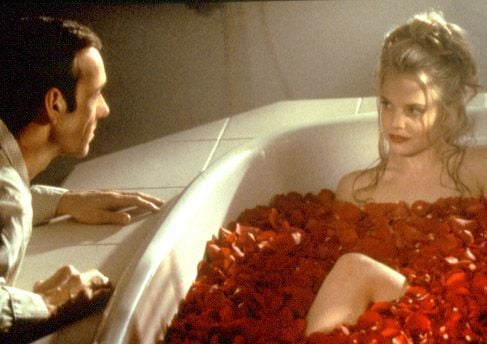
American Beauty


I was discussing movies with Swati today when she asks me " what do you really like about this movie ? " while we were discussing American Beauty. Humm!! I'd never given it so much of thought.

The movie begins with Kevin Spacey introducing himself in the narrative. " My name is Lester Burnham...in less than a year I will be dead. Of course I don't know that yet, and in a way, I am dead already." Now that simply "kills" the prospect of having an interesting climax, does it not?

Next, we know that Lester's life is beset by sexual frustrations and he decides to take matters in his own hands, in the only way he likes - literally. His sarcasm only goes to highlight his depression when he says "this will be the high point of my day. It's all downhill from here." Can it really catch your interest?

"My job consists of basically masking my contempt for the assholes in charge", says Lester, who in his own words, has, for 14 years, been a whore for the advertising industry. In the first 10 minutes of the movie, one cannot overlook the dialogues which are humourous and brutally honest. But you're left wondering where does all this lead to?

" It's a great thing when you realize you still have the ability to surprise yourself." The debutant director Sam Mendes definitely believes in this adage and also in his characters and the script. Add to that the memorable sound track and cinematography that's from the top drawer. The ingredients seemed well set for a perfect recipe, but the seasoning which the audiences savoured long after the movies release in 1999 was provided by Kevin Spacey. In his oscar winning performance, Spacey gets us to love the loser. He suddenly emerges from the stereotypes and turns them upside down.

" Today is the first day of the rest of your life ". He revels in the decay and disharmony of his miserable life as he finds inspiration in the form of a mini-skirted Angela Hayes, his daughter's cheerleader friend. His lust for the teenager brings back all the exuberance of his adolescent years as Lester takes to weed, the gym and a job at a burger joint. With some unforgettable tracks from Bob Dylan and The Who in the background, Lester seems to catch up on all the joys lost during his apparently comatose years.

This however is not lost on his family. " I need a father who's a role model, not some horny geek-boy who's gonna spray his shorts every time I bring a girlfriend home from school." says Jane, who's yet to experience and appreciate paternal affection. And now you suddenly witness the dark humour of Lesters life, with greater emphasis on the dark side. The movie reaches the climax, encompassing whiplash changes of mood, orchestrated with exquisite control and fluid grace. Lesters life, unlike what the movies posters and his fantasies had us believe, is no bed of roses. And with the movie, his life comes to an end.

But it is not without its share of irony, neatly wrapped under layers of poignancy. There is a scene where Ricky, Jane's wierdo of a boyfriend is transfixed by an image of a plastic bag caught on video, whipped around by the wind in an empty parking lot.
" It was one of those days when it's a minute away from snowing and there's this electricity in the air. This bag was, like, dancing with me. And that's the day I knew there was this entire life behind things." That probably sums up what Sam Mendes wanted audiences to see through the eyes of all his neatly sketched characters in American Beauty.

I'm still to get over Lester's posthumous soliloquy,

"I had always heard your entire life flashes in front of your eyes the second before you die. First of all, that one second isn't a second at all, it stretches on forever, like an ocean of time. For me, it was lying on my back at Boy Scout Camp, watching falling stars. And yellow leaves, from the maple trees that lined our street. Or my grandmother's hands, and the way her skin seemed like paper. And the first time I saw my cousin Tony's brand new Firebird. And Janie... and Janie. And... Carolyn. I guess I could be really pissed off about what happened to me, but it's hard to stay mad, when there's so much beauty in the world. Sometimes I feel like I'm seeing it all at once, and it's too much, my heart fills up like a balloon that's about to burst. And then I remember to relax, and stop trying to hold on to it, and then it flows through me like rain. And I can't feel anything but gratitude for every single moment of my stupid little life. You have no idea what I'm talking about, I'm sure. But don't worry... you will someday."

I certainly have no idea of what it is to experience the last second of my life. I 'm left wondering what images will flash in front of my eyes in the last 100 metres of my free-fall. As it stands, I'm sure I've certainly not lived a great life, not great enough to die for. But a movie like American Beauty does open my eyes. It inspires me to savour every moment of my life and render it worthy of a pleasant viewing as it flashes in front of my eyes, someday.

Sunday, July 8, 2007

All roads lead to "Roma": Movie Review


Federico Fellini's Roma is an autobiographical tribute to Rome, Italy, featuring a narration by Fellini himself and a mixture of real-life footage and fictional set pieces. What sets this movie apart is the fact that it lacks plot. In fact it is an autobiography of a proud Roman, but hardly a story of one individual. The movie starts with Fellini’s first impressions of the city as a student. The nostalgia is clearly evident in the scene when an instructor leads a group of students on an excursion. On the banks of River Rubicon is a revision of Caesar’s “Alea iacta est” before the wards follow their instructor and cross the river enroute Rome. Probably the sequence is reminiscent of Fellini’s childhood.


Suddenly after this is an artistic impression of Rome in the 30’s. After we are introduced to the city, we witness the director's early years, arriving in Rome in 1931 during the time of Mussolini. The 18 year old moves into a tenement building and then embarks on a wild journey as he is inducted into the carnivalesque culture of Italian street life. To accentuate the effect of this breathtaking sequence are the elements of projected light and layered yet amplified sound. The road side eatery is well lit and vibrancy of the ambience is exemplified by the colourful dishes that are being served. The background score is a babel of shouting voices, of customers satisfied or otherwise, of couples fighting, of children playing Football and celebrating a goal, of mothers grumbling and toddlers crying, of waiters shouting out the menu to fresh customers, of tramps who sing and dance to entertain and earn their meal; all this sandwiched between Nino Rota's wonderful music and sharp witty sarcastic dialogues like “ Who’s that? Lellos daughter?” “ Whose do you think, the priests?” “ In Rome, we say no matter what we eat, it all turns to shit”.


The movie however is inconsistent with chronology. The charms of the past are ever present, but often the audience is teleported 40 odd years into the future where a film crew is making a movie on Rome. Throughout the movie there’s never a clear distinction between the past and the present. It is possibly to showcase certain aspects of the culture which do not change with time. The overlapping of the past and the present and the continuation of one within the realms of the other is best shown in this sequence where the film crew is on a site seeing trip inside the newly built sub way tracks. Inside the tunnels, labyrinthine catacombs lead to an ancient roman house, buried several kilometers below the present day Rome. What is unveiled is a spectacular sight. We are shown a glimpse of the past in the cave which is laden with frescoes and statues. But this scene is brief as we see that on being exposed to the atmosphere, these artifacts reveal a thick layer of dust and physical decay, which gives us an idea of a number of centuries that these pieces have endured.


Fellini also employs a style that shifts between the narrative and the documentative, fantastical fiction interwoven with farcical facts. There is this scene when the present day world bows to natures fury. The traffic is stranded because of heavy rain and there is chaos everywhere but in the backdrop,braving the storm bravely is the colloseum. The director’s dexterity is well advertised with his handling of prostitution. The brothels are portrayed the way they ought to be, as one of the ills of society, but the portrayal as such is incredibly chaste. The movie aptly ends with a motorcycle rally at night. The shots of impressive buildings at night with the motorcycles’ vrooming noises in the background is artistic, to say the least.

To sum up, Roma is a love story, where a man professes his love for the city he’s a part of. It’s a tribute to Rome by one of her most famous sons. Your first viewing will invariably result in an infatuation, both for the city and the movie. It is surreal but not very distant from reality. But to enjoy this movie, a viewer should be willing to give it some time. After all, Rome was not built in a day. Nor was Fellini’s masterpiece.

Wednesday, June 27, 2007

Chura liya....


27th June 2007 happens to be the 68th birth anniversary of the late R.D Burman or Pancham da as he was affectionally called by his collegues and friends.The title for this entry shares it name with what remains my favourite Bollywood number. The title, however is also apt because of what I discovered a few months back. Today may not be the best day for an expose, it being his birth anniversary. What prompted me to post this entry today was this tribute in the newspaper.
When Bhumikak wrote "bringing world music to our ears through hindi films, words are'nt enough to describe what burman did", I interpreted it literally.I do realise that a statement like this would be nothing short of blasphamy. Afterall, Pancham da occupies a sacroscant space in the heart of every hindi-movie lover.I am not trying to question the talents of the maestro,I only doubt his creativity as a music composer. It turns out some of his best numbers were "inspired" from the works of artists whose background varied from the Americas to the far east.
I turned out to be a huge RD Burman fan after the release of what is now remembered as his swansong - "1942,A Love Story". It piqued my curiosity as it did for many who had had the better fortune of growing up to his melodious tunes in the 70's and in the following decades.I followed his works after his unfortunate demise in 1994 and was forced to listen to his works in the reverse order of chronology.His works were path breaking compared to all his contemporaries. But as I was exposed to western pop in my adolescent years, I realised Burman owed much to the likes of ABBA, Chubby Checker, Elvis, The Carpenters, The Beach Boys, The Beatles, Cliff Richards and Frank Sinatra to name a few. My own inclination towards jazz music more recently however led me to this serendipitous discovery, which really blew my mind away. Readers please check out Demis Roussos’ "Say you love me" and you'll know what I mean.Roussos' third album, released in 1974, inspired Sholay's "Mehbooba Mehbooba", which was released the following year. Till I discovered this fact, I'd listed down this song as my favourite bollywood track as it was so ahead of its times. I'd imagined that it as a song inspired many a musician to explore new realms of creativity. Suddenly I felt a little betrayed.
Now as I look at it dispassionately and objectively, it did probably spawn a breed of pseudos with great musical tastes to try out a hand at composing music.Afterall, We must remember "Akele Hum Akele Tum", Anu Malik's magnum opus till then as probably bollywoods best tribute to Wham,Deep Purple and the Godfather. Burman however should be remembered as an individual who revolutionised the Indian music industry by his sheer talents.By featuring in Jose Flores' Pantera, he did put India on the world music map. Creativity or the lack of it notwithstanding, I'd still list down the folling as my favourites:
1. Monica, oh my darling (caravan)
2. Hare Krishna Hare Ram ( movie of the same name)
3. Chingari koi badkhe ( amar prem)
4. Kati patang ( movie of the same name)
5. Chura liya ( yaadon ki baarat)
6. Tere bina zindagi se koi ( andhi)
7. Tumse naraz nahi ( masoom)
If any of these have been "inspired", i'd just overlook any such info and say "Ignorance is bliss".